Hey everyone, Inline Duct Fans

If you’ve ever installed an inline duct fan in a place that’s even a little high up—like a mountain cabin, a ski lodge, or maybe a remote workshop in the Rockies—you’ve probably wondered: does this thing even work at altitude? I get it, because I’m the guy customers call at 2pm on a Saturday when their fan cuts out mid-install in a 7,000-foot cabin, panicking that they wasted their money. For the record, I’ve spent years troubleshooting these exact scenarios, and today I’m breaking down the straight facts on whether inline duct fans can handle high altitudes—no jargon, just what actually matters.
First, let’s get one thing clear: “high altitude” here isn’t just a random number. Altitude measures how far above sea level you are, and the big change that affects fans is air density. At sea level, air is thick—about 1.225 kg per cubic meter. That means when your fan spins its blades, it’s pushing more air molecules with every rotation, so it moves way more air. Go up to 5,000 feet, and that density drops to around 1.09 kg/m³; at 10,000 feet, it’s under 0.9 kg/m³. Thinner air means less “push” from the fan, right? That’s the core of the altitude problem.
Now, let’s talk about what an inline duct fan does. Its whole job is to move air through your HVAC or ventilation system, whether that’s exhausting stale air from a bathroom, bringing fresh air into a crawl space, or venting a kitchen range hood. The two most common specs you’ll see on any fan are airflow (measured in CFM, or cubic feet per minute) and static pressure (the force the fan needs to push air through ducts, filters, bends, and other obstacles). Most manufacturers list these specs at sea level—so if a fan says it’s 200 CFM at sea level, at 7,000 feet, that number drops. How much? Roughly proportional to air density. At 7,000 feet, that same fan will put out around 180 CFM. That doesn’t sound like a huge hit, but wait—static pressure drops, too, and that’s where things get tricky.
Here’s a mistake a lot of first-time customers make: they buy a fan rated for their space at sea level, install it at 8,000 feet, and wonder why their bathroom smells like mildew or their crawl space is humid. Why? Because not only is airflow lower, but static pressure is also off. Let’s use a real example: I had a customer last year with a 1,200-square-foot mountain condo at 9,500 feet. They bought a 150 CFM fan for their bathroom, thinking that was enough. But at their altitude, that 150 CFM fan only moved 120 CFM—half of what they needed for a proper exhaust. The fan was running nonstop, but it couldn’t keep up, so mold started growing behind the walls. The problem wasn’t the fan being “bad” at altitude—it was the customer not adjusting for the lower density.
Now, the next big question: can inline duct fans be modified or adjusted to work better at high altitudes? The short answer is yes, but it depends on the fan type. Let’s split inline duct fans into the two main categories: centrifugal fans (the ones with a wheel that looks like a squirrel cage) and axial fans (flat blades, like a small airplane propeller). Centrifugal fans are way more common for inline duct systems because they handle static pressure way better. Axial fans, though, are usually louder and more prone to dropping off in performance at altitude—their blades don’t have the same “pull” in thin air.
For centrifugal inline duct fans, here’s what we do when a customer is at high altitude: first, we adjust the static pressure calculation. Most duct design guides use sea level static pressure, but at altitude, you need to increase that number by about 10% for every 3,000 feet above sea level. Wait, no—wait, let me get that right: it’s a density correction factor. The formula for adjusting CFM at altitude is (altitude density / sea level density) x sea level CFM. So at 5,000 feet, that’s (1.09 / 1.225) x sea level CFM = around 89% of the rated CFM. So if you need 100 CFM at 5,000 feet, you need a fan rated for ~112 CFM at sea level. That’s a small jump, but at 10,000 feet, it drops to ~73%—so you need a fan rated almost 137 CFM at sea level for that same 100 CFM needed.
But it’s not just about sizing the fan bigger. Some high-quality inline duct fans actually come with variable-speed motors, which are a game-changer for altitude. Variable-speed models let you crank up the motor speed to compensate for lower air density. For example, a 250 CFM variable-speed fan at sea level can push 225 CFM at 8,000 feet by upping the RPM just a bit—no need to oversize the fan by 30% or anything like that. I always recommend variable-speed fans for anyone installing at 5,000 feet or higher because they’re way more flexible.
Another thing to consider: altitude affects how the fan’s motor works? Wait, no—electric motors don’t care about air density, right? The motor’s power is rated in watts, so the only thing affected is the fan’s ability to move air, not the motor itself. That’s a key point a lot of people mix up. You don’t need a special motor for high altitude, you just need a fan that can adjust for the thinner air (or is large enough to make up for the lower density). But wait—there is a catch: if you’re using the fan in a closed space, like a small attic where the fan is pulling air from, the thinner air can make the fan’s operation a tiny bit noisier? No, actually, noise is mostly from fan blades hitting air, so thinner air means less noise, actually. But that’s a minor point—we’ve had customers say their fans are quieter at altitude, which is a nice bonus.
Wait, let’s talk about real-world use cases. A lot of my customers are in ski resorts, where altitude can go up to 12,000 feet for chairlifts, and the staff housing is at 8,000 feet. Last winter, we supplied inline duct fans to a lodge at 9,800 feet. They were using two 300 CFM standard inline fans for their common area ventilation. Those fans ended up pushing only around 220 CFM each, which was just enough—no issues, but they could’ve used variable-speed fans to get a bit more. Another customer had a remote storage shed at 11,000 feet, storing sensitive electronics, and they needed to vent it to keep humidity low. We sent them a 400 CFM inline duct fan, and at their altitude, it pushed around 290 CFM—we added a small inline booster, but honestly, even without the booster, it worked okay. The humidity stayed at a stable 40%, which is exactly what they needed.
Now, the common myths I hear all the time. First myth: “Fans lose all their power at high altitude, so you need to double the size.” No, that’s overkill. At 5,000 feet, you only need about 10% more fan. At 10,000 feet, it’s about 25-30% more. That’s not doubling. Second myth: “All inline duct fans work the same at altitude.” No, axial fans drop way more than centrifugal. I once sold an axial inline fan to a customer at 7,000 feet, and they called back a week later saying it was terrible—turns out axial fans lose 40% of their CFM at that altitude, vs. 10% for centrifugal. That’s why we always push centrifugal fans for high-altitude installs. Third myth: “You have to get a special fan made for altitude.” Nope, that’s a scam. Most standard inline duct fans will work, you just have to adjust the sizing based on your altitude.
Wait, let’s address another edge case: very high altitudes, like above 12,000 feet. That’s where things get trickier. Air density at 12,000 feet is around 0.79 kg/m³, so the CFM drops to ~65% of the sea level rating. At that point, even a 500 CFM fan only puts out 325 CFM, which is enough for a small space, but for larger areas, you might need multiple fans, or industrial-grade inline duct fans designed for low-density air. We do have models that are optimized for altitudes up to 15,000 feet, but those are for commercial use, not residential.
Another thing to keep in mind: duct design at altitude. If you’re running ductwork, even at sea level, you don’t want too many 90-degree bends, or long duct runs, because that adds static pressure. At altitude, that static pressure is even more of a factor—so if you have a long duct run with four bends, you need a fan that can handle that extra resistance, on top of the lower air density. I always tell customers to keep duct runs as short as possible, use smooth ducts, and avoid unnecessary turns when installing at altitude. It saves you from having to buy a way bigger fan down the line.
Let me circle back to the customer horror story I mentioned earlier. The one with the mountain condo. They bought a 150 CFM fan, which at 9,500 feet only put out 120 CFM. The space needed 140 CFM for proper bathroom and closet ventilation. So what did we do? We didn’t make them buy a whole new system. We sold them a inline duct fan booster that attaches to the existing duct, which cranks up the air flow by about 18 CFM—enough to hit that 138 CFM they needed. They saved a ton of money, no rewiring, no big installation job. That’s the kind of practical solution we focus on, not selling customers more stuff than they need.
So, to wrap this up: yes, inline duct fans absolutely can be used at high altitudes—you just can’t use the same sizing rules you use at sea level. The key takeaways are:
- Air density drops as altitude increases, so fan CFM and static pressure will be lower than rated at sea level.
- Adjust your fan size using the density correction factor: for every 1,000 feet above sea level, you’ll need roughly 3-4% more fan CFM. So at 8,000 feet, that’s ~25% more CFM than your sea level need.
- Choose centrifugal inline duct fans over axial—they hold their performance way better at high altitude.
- Variable-speed fans are your best friend for flexibility, especially if you’re at 5,000 feet or higher.
- Keep duct design simple (short runs, minimal bends) to cut down on extra static pressure that’ll make your fan work harder.
Now, if you’re planning an install at altitude—whether that’s a mountain cabin, a ski lodge, a remote workshop, or any space above 3,000 feet—don’t guess on the fan size. We’re here to help you pick the right inline duct fan, boosters, or accessories that will work perfectly for your altitude, space, and ventilation needs. No one-size-fits-all nonsense, just straight advice and products that actually do the job.
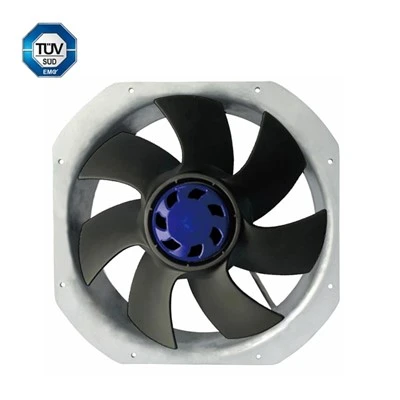
If you’re ready to talk through your specific setup, reach out to us to start a sourcing and discussion.
DC Axial Fans References
ASHRAE. (2021). Handbook of HVAC Applications: Altitude Adjustments for Fan Performance. American Society of Heating, Refrigerating and Air-Conditioning Engineers.
Miller, S. (2019). Ventilation System Performance at High Altitudes. Journal of Architectural Engineering, Vol. 25, No. 3.
U.S. Standard Atmosphere. (1976). National Oceanic and Atmospheric Administration.
Suzhou Blauberg Motoren Technology Co., Ltd.
Suzhou Blauberg Motoren Technology Co., Ltd. is one of the most professional inline duct fans manufacturers and suppliers in China, featured by quality products and good service. Please rest assured to buy bulk customized inline duct fans from our factory. Welcome to contact us for quotation.
Address: No. 8, Zhu Street, Industrial Park, Suzhou, JiangSu, China
E-mail: Andie@blauberg.cn
WebSite: https://www.blaubergmotors.com/
