If you’ve ever stared at a stick-built home on your commute and thought “why is that thing taking 6 months to go up?”, I get it. As a modular house supplier who’s worked on 100+ builds over the last 8 years, the question I get most from customers is not “is modular better?” — it’s “how much is this actually gonna cost me, start to finish?” The short answer is it’s not a one-size-fits-all number, but I’m gonna break down every real, out-of-pocket cost you’ll face when building a modular home from scratch, no fancy jargon or hidden fees. Modular House
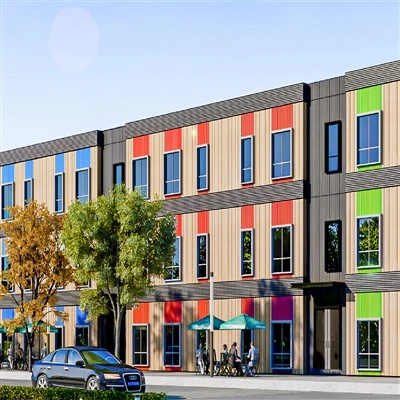
First off, let’s clear up the biggest misconception: modular houses aren’t the same as mobile homes. Mobile homes are built in a factory, but they sit on a steel chassis and move after delivery (or are meant to stay temporary). Modular homes are built just like stick-built — they’re on a permanent foundation, use the same lumber, wiring, and insulation codes as local code, and most banks treat them the same way as traditional homes. That means your costs will line up with what you’d pay for a stick-built, minus the wild delays and site hassles.
Let’s start with the factory build itself, because that’s where most people base their budget. This is the actual modules — the walls, floors, roof sections — built in a controlled factory, rain or shine, no waiting for materials to show up on site. For a basic 1,500 sq ft 3-bedroom, 2-bath home (super common for first-time buyers or small families), the factory module cost usually lands between $65,000 and $95,000. Wait, that’s a big range, right? Let’s break that down: $65k is a barebones base model — no upgrades, standard cabinets, laminate countertops, basic carpet. The $95k is a mid-range pick: quartz counters, hardwood floors, stainless steel appliances, a little extra square footage for a home office or a garage module. If you go bigger — 2,000 sq ft or more, with a second story added — that jumps to $100k to $140k. A tiny home-style modular? That’s 400 to 600 sq ft, so $25k to $45k total for the modules.
But hold on — that’s only the factory part. You still have to prep the site and set the modules, which is its own cost. Let’s talk site work first. If you already own a plot, great, but if you’re buying land, add that — average residential land in the U.S. is $3,000 to $8,000 per acre, but if you’re only buying a 0.2 to 0.5 acre plot (enough for a small house), that’s $600 to $4,000. But most of the time, site work is the biggest variable here. First, you need a foundation — no way around that. For a basic slab foundation (the cheapest option for flat land), that’s $4,000 to $10,000. If your land is sloped, you might need a crawl space or a full basement, which runs $12,000 to $30,000. Crawl space is cheaper than a basement, but basements add extra living space later if you want it. Then there’s site prep: clearing trees, leveling the land, grading for drainage (super important, don’t skip this — you’ll get foundation leaks otherwise), and hooking up utilities. Utility hookups are a big one: electric, water, sewer, gas, and internet. If your plot is already near all those lines, that’s $3,000 to $8,000 total. If you’re way out in the country where you have to run lines 1,000 feet or more, that can jump to $15,000 or even $25,000. Add in a driveway and a small walkway to the front door, and that’s another $2,000 to $5,000.
Next, transporting the modules from the factory to your site. Most factories are within 500 miles of where you’re building, so distance is the main cost driver here. A standard load for a modular home is 60 to 80 feet long, so you can’t just load it on a regular semi — you need specialized transport trucks, permits for oversize loads, and police escorts if it’s a long distance. For a home under 2,000 sq ft, transport is usually $3,000 to $10,000. If you’re 500+ miles from the factory, that can go up to $15,000. And if you need to move utilities or traffic signs temporarily to get the modules down your road, that adds a couple thousand more — I’ve had customers hit with $2,500 for a single temporary road closure permit.
Then there’s setting the modules and connecting them on site. Once the truck drops the modules, you need a crane big enough to lift them and set them on the foundation. A crane for a 1,500 sq ft home is $1,500 to $4,000, and that includes the labor to set each module. Then you have to seal the gaps between the modules, run the electrical, plumbing, and HVAC lines between the sections — that’s another $5,000 to $10,000. Wait, a lot of people forget HVAC! Modular homes come with pre-plumbed and pre-wired, but you still need to hook up the central AC, furnace, or heat pump. For a small home, that’s $3,000 to $6,000. For a bigger 2,500 sq ft home, that jumps to $8,000.
Now, the final touches that add up fast. Trim work, drywall finishing, painting, exterior siding, windows and doors. Wait — the factory usually includes basic windows, but if you want energy-efficient double-paned ones or bigger picture windows, that’s extra. For a standard home, windows and doors are $4,000 to $8,000. Siding: vinyl is cheapest, $3,000 to $7,000; wood or fiber cement is nicer, $7,000 to $12,000. Then interior finishing: baseboards, crown molding, paint — that’s $3,000 to $6,000 total, depending on how many rooms you have. And don’t forget the exterior stuff: a small porch, a deck, landscaping. That’s $5,000 to $15,000 if you want it.
Wait, let’s add all that up for a mid-range 1,500 sq ft home to get a real number, so you can see where you stand. Factory module: $80,000. Land (small plot): $2,000. Site prep + foundation + utilities: $12,000. Transport: $6,000. Crane + module connection: $7,000. HVAC: $4,000. Windows + siding + interior finishing: $15,000. Deck + landscaping: $5,000. Total is $131,000. That’s way cheaper than a stick-built home of the same size, which averages $150,000 to $180,000 for the same area — and modular takes half the time to build, usually 2 to 4 weeks on site, plus a week or two of factory prep, vs 6 to 12 months for stick-built.
But wait, what are the hidden costs people almost always miss? Let’s talk about permits and inspections. You need a building permit for the modular home, same as stick-built. Permit costs depend on your county, but average $1,000 to $3,000. Also, modular homes need to pass the same local inspections as stick-built — foundation inspection, module connection inspection, final inspection — and those are usually $500 to $1,500 total. Another hidden one: utility deposits. Electric, water, sewer, and internet companies usually charge a $500 to $1,000 deposit to turn service on, especially if you’re a new customer. And if you’re buying a used modular home (wait, we sell new ones, but I’ve had customers ask about used), that’s a whole different number — used modules are $20,000 to $50,000, but you have to check for structural damage, and transport might be more expensive because they’re older and sometimes bigger.
Is there a way to cut costs? Yeah, but be careful — don’t skimp on things that will cost you more later. Basic tips: go with a smaller floor plan, pick standard factory finishes instead of custom upgrades, build on flat land to cut site prep costs, and keep your distance from the factory to avoid high transport fees. The biggest mistake people make is trying to save $5,000 on a cheap foundation that leaks a year later, costing $10,000 to fix.
Now, if you’re thinking “this seems manageable, but I don’t know where to start” — that’s what I’m here for. Every customer’s build is different, so I can help you figure out exactly what your numbers will be, no guesswork. We work with families, first-time buyers, even small developers, so whether you want a tiny 500 sq ft home or a 2,500 sq ft family house, we can walk through your options, adjust for your land, and give you a clear breakdown with no hidden fees.

If you’re ready to talk through your build, don’t hesitate to reach out. We’ll answer all your questions, show you past builds we’ve done, and help you get a tailored quote that fits your budget. No pressure, no sales pitches — just honest numbers for a home that’s up in a fraction of the time, built to last.
Light Steel Villa References:
- U.S. Department of Housing and Urban Development. (2022). Modular Housing: A Guide for Homebuyers.
- National Association of Home Builders. (2023). Cost Comparison of Modular vs. Stick-Built Homes.
- Modular Building Institute. (2021). Transport and Installation Guidelines for Permanent Modular Structures.
- Local Building Code Standards for Residential Construction, 2024 Edition.
Lvke Prefabricated Building (Suzhou) Co., Ltd.
With abundant experience, we are one of the most reliable modular house manufacturers and suppliers in China. Please feel free to wholesale custom made modular house at competitive price from our factory. Good service and quality products are available.
Address: 102, #8 JinPu Road, SuZhou, China
E-mail: Ray.li@lvkegroup.cn
WebSite: https://www.lvkebuilding.com/
