If you’ve ever worked in water treatment, mining, or wastewater management, you’ve probably heard the terms “thickener” and “clarifier” thrown around like they’re interchangeable. But if you’re shopping for equipment—and especially if you’re specifically in the market for a peripheral drive thickener—you know there’s way more to it than just two machines that move sludge around. I’ve been selling peripheral drive thickeners for almost a decade now, and one of the most common questions I get from new customers is: “What’s the actual difference between a thickener and a clarifier, and why does a peripheral drive even matter?” Let’s break this down plain and simple, no stuffy engineering jargon that makes your eyes cross. Peripheral Drive Thickener

First, let’s start with what both machines have in common: they’re both large, round tanks (usually) that use gravity to separate solids from liquids. That’s where the similarity ends. The core goal of each is totally different, and that goal dictates how they’re built, how they run, and when you’d pick one over the other.
Let’s kick off with the clarifier, since that’s probably the one most folks have a passing familiarity with. A clarifier’s whole job is to clean water by removing as much suspended solids as possible, fast. Think of it like a big settling pool: you pump raw, dirty water (say, effluent from a sewage plant, or run-off from a mine site) into the center of the tank, slow it down so the tiny solid particles can sink to the bottom, and then skim the clear, clean water off the top to send back out for reuse or discharge. That settled stuff at the bottom? It’s called sludge, but it’s super thin—usually only 1-3% solids. The clarifier’s job ends there; that thin sludge is either sent to a separate thickener for further processing, or disposed of right away if it’s not loaded with heavy solids.
Now, the thickener—specifically a peripheral drive thickener, which is what I supply—does the opposite. It doesn’t care about making super clean water; it cares about concentrating sludge into a thick, pumpable (or easy-to-transport) cake. The goal here is to squeeze as much water out of the solids as possible to reduce volume. A thickener takes that same incoming slurry (the sludge from a clarifier, or raw underflow from a mining process) and thickens it up to 10-30% solids, sometimes even more depending on the application. That’s a huge difference in volume: if you start with 10,000 gallons of 2% solids sludge, you only end up with around 1,300 gallons of 15% solids thickened sludge. That cuts down on transportation costs, storage space, and disposal fees by a ton.
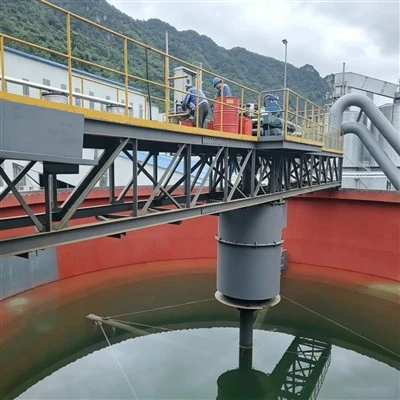
But how does the peripheral drive part come into play here? That’s where a lot of people get confused. Both thickeners and clarifiers use some kind of drive system to move the rakes at the bottom of the tank. The rake is a set of arms that stirs the settled solids and pushes them toward a central hopper at the bottom of the tank, so you can pull them out. There are two main drive types: center drives and peripheral drives. Center drives have the motor and gearbox right in the middle of the tank, connected to the rake arms. Peripheral drives—my bread and butter—mount the motor and gearbox on the outer edge of the tank, and use a big gear ring or a set of wheels around the perimeter to turn the rake arms.
So why pick a peripheral drive thickener over a center drive, even within the thickener category? Let’s get into the pros here, because that’s what makes my equipment worth talking about. First, peripheral drives are way better for large tanks—like, 50 feet in diameter and up. Center drives can struggle with the torque needed to move heavy, dense sludge in big tanks, and they’re more prone to stress or breakdown because the entire load is concentrated in the middle. Peripheral drives spread the torque around the edge of the tank, so they handle thick, heavy sludge way more efficiently. If you’re processing mining tailings, for example, that sludge is full of sand and minerals that are way denser than sewage sludge, so you need a drive that can power through that without bogging down.
Another big plus is maintenance. With a peripheral drive, all the working parts are on the outside of the tank, not submerged under hundreds of gallons of slurry. When you need to inspect, lubricate, or replace a part, you don’t have to drain the whole tank and climb in the muck—you just walk around the edge. That cuts down on downtime, which is huge for operations that run 24/7, no days off. Center drives mean you’re reaching into a wet, corrosive environment, which is way harder on equipment and your maintenance team.
Wait, but let’s make sure we’re not mixing up drive types with the core machine difference. I still run into people who say, “Oh, I need a peripheral drive, so that means I need a thickener.” No, that’s not right. You could technically put a peripheral drive on a clarifier, but it’s not designed for that. Clarifiers don’t need the heavy-duty torque that thickeners do, and their sludge is way thinner, so the rake system doesn’t have to work as hard. A peripheral drive thickener is built specifically to handle thick, dense sludge, with heavier rake arms, higher torque, and a design that focuses on concentrating solids, not just separating them.
Let’s use a real example to make this concrete. Say you run a municipal wastewater treatment plant. You’ve got a primary clarifier that takes raw sewage, settles out big solids, and sends that thin sludge (2% solids) to a thickener. If you used a clarifier instead of a thickener for that sludge, you’d end up with the same thin 2% stuff, which would cost you 5x more to haul away to a landfill. If you used a small center drive thickener for a small plant, that works, but if you’re a big plant processing 1 million gallons of sludge a day, you need a 100-foot tank. A center drive on that size would be expensive to install, and the motor would have to be massive to handle the torque. A peripheral drive thickener on that same tank size is cheaper to install, runs more smoothly, and uses less energy.
Another example: a gold mining operation. When they process ore, they grind it up, mix it with water to make a slurry, and separate the gold using chemicals. The leftover tailings (the waste) are a thick, sand-heavy slurry that’s got to be thickened before they pump it to a tailings pond. If they tried to use a clarifier here, the tailings would only have 2% solids, so the pond would fill up way faster, and they’d have to add more water, which means more transportation costs to move that extra water. A peripheral drive thickener would thicken that tailings to 25% solids, cutting the volume by almost 90%—that’s a game-changer for mining operations, which spend millions on tailings management every year.
Now, let’s talk about when someone might actually mix these two up. I’ve had a customer call me last year saying, “I need a clarifier for my industrial effluent,” and when I asked what he’s trying to do, he said, “I need to remove solids so I can pump the leftover stuff to reuse.” Turns out, his effluent was a mix of metal shavings and water, and he needed those solids thickened so he could haul them to a recycler. He thought a clarifier would get him there, but he really needed a thickener. That’s the mistake a lot of people make: they see a tank, think it’s the same, but the end goal is everything.
Let’s clear up a few myths here. First myth: “Thickeners are just bigger clarifiers.” No, they’re not. A 30-foot thickener doesn’t do the same thing as a 100-foot clarifier, even if the tank is round and has a rake. The internals are totally different: thickener rakes are heavier, have more blades that angle to push solids toward the center instead of just settling them, and the tank design is steeper at the bottom to make thickening easier. Clarifiers have a shallower bottom to let light solids settle without compacting too much.
Second myth: “Peripheral drives are only for thickeners.” I’ve seen peripheral drive clarifiers used for small applications, but they’re not common. Clarifiers don’t need the high torque that thickeners do, so center drives are cheaper and more practical for clarifier tanks up to 80 feet. Once you go over 80 feet, even clarifiers might use peripheral drives, but that’s more for structural reasons than for thickening.
Third myth: “You can use the same drive for sludge and effluent.” Nope. Sludge is a sticky, dense material that can gum up rakes and require more power. Effluent is usually lighter, with finer particles that settle slower, so the drive doesn’t need as much torque. Mix those up, and you’ll end up with a stuck rake, a broken motor, or a tank that doesn’t do what you need it to.
Now, let’s circle back to why this matters for your operation. If you’re running a water treatment plant, mine, or any industrial facility that processes solids, getting the right machine isn’t just about buying equipment—it’s about saving money, reducing downtime, and meeting regulatory requirements. If you pick a clarifier when you need a thickener, you’re looking at higher disposal costs, more frequent tank emptying, and maybe even fines if your sludge isn’t compliant with local rules. If you pick a center drive thickener when you need a peripheral drive, you’re looking at more breakdowns, higher energy bills, and shorter equipment lifespan.
I’ve seen customers who made the wrong call end up wasting tens of thousands of dollars. One guy bought a small center drive clarifier instead of a thickener for his construction site’s slurry, and after three months, he was paying twice as much to haul the thin sludge, and the clarifier’s rake broke twice because it wasn’t built for heavy sand. He ended up calling me to pick up the old machine and install a peripheral drive thickener, and he saved over $15,000 a year in disposal costs after that.
So, to recap the key differences, in case you’re skimming:
- Core Goal: Clarifiers clean water (remove suspended solids to get clear effluent), thickeners concentrate solids (reduce volume of sludge for disposal/reuse).
- Solids Content: Clarifier sludge is 1-3% solids, thickener underflow is 10-30% solids.
- Design: Clarifiers have shallow tanks, light rakes; thickeners have deep, steep-bottom tanks, heavy-duty rakes.
- Drive Type Fit: Center drives work for small clarifiers or small thickeners; peripheral drives are better for large thickeners (over 50ft diameter) handling dense, heavy sludge, with easier maintenance.
If you’re still not sure which one you need, or if a peripheral drive thickener is right for your application, don’t guess. Every operation is different—mine tailings, municipal sludge, industrial effluent all have unique properties, and the right machine depends on your flow rate, solids type, and budget. I’ve helped customers across industries figure this out over the years, and I can walk you through what works best for your specific setup.
If you’re ready to upgrade your solids processing equipment, or just want to chat about how a peripheral drive thickener could save you money on disposal and maintenance, reach out to connect for a procurement discussion. I’m always happy to break it down further without all the engineering jargon.
Travelling Bridge Sludge Scraper References
- Wastewater Engineering: Treatment and Reuse, Metcalf & Eddy, McGraw-Hill Education, 2003.
- Thickener Design and Operation for Mineral Processing, Society for Mining, Metallurgy & Exploration, 2011.
- Clarifier and Thickener Technology for Industrial Water Treatment, Water Environment Federation, 2018.
- Peripheral Drive vs. Center Drive Rake Mechanisms: Performance and Maintenance, International Water Association, 2020.
Shandong Ningye Machinery Equipment Co., Ltd.
Shandong Ningye Machinery Equipment Co., Ltd. is one of the most reliable peripheral drive thickener manufacturers and suppliers in China. With abundant experience, we warmly welcome you to buy discount peripheral drive thickener made in China here from our factory. Quality products and low price are available.
Address: Workshop No.16, Dongcao Village Industrial Park, Guangda East Road, Songguantun Subdistrict, Economic and Technical Development Zone, Dezhou City, Shandong Province
E-mail: wjkningye@cn-ningye.com
WebSite: https://www.cn-ningye.com/
