If you’ve ever stood in front of a wooden smart door at a residential building or boutique office, you’ve probably wondered the same thing: “Does this thing actually close itself?” As a supplier who’s spent the last 7 years testing, building, and installing wooden smart doors for homes and small commercial spaces, I get this question all the time. It’s not a trivial one—for customers, self-closing functionality ties directly to security (a gaping door is an invitation for unauthorized access), energy efficiency (leaving a door ajar wastes heating or cooling), and even basic convenience (no more scrambling to catch a door mid-swing with your hands full of groceries or office supplies). Wooden Smart Door

Before I break down the answer, let’s set something straight: not all wooden smart doors have a built-in self-closing feature, and that’s intentional. A lot of brands cut corners here to keep costs low, but after thousands of field tests, I can tell you that when designed correctly, a self-closing wooden smart door isn’t just a gimmick—it’s a core part of its functionality.
First, let’s talk about how self-closing systems work in wooden doors, specifically, because wood is different from steel or aluminum. Steel doors are rigid, so they can support heavy spring mechanisms without warping. Wood, on the other hand, is a natural material with slight expansion and contraction from humidity and temperature changes—so a one-size-fits-all spring can damage it over time. That’s why we don’t use the old-style door closers you see on commercial storefronts; they’re too harsh for solid wood, which is why a lot of cheaper smart door manufacturers skip this feature entirely.
The self-closing systems we actually use (and recommend) for our wooden smart doors fall into two main categories, both tailored to wood’s properties. The first is a hydraulic hinge system, integrated right into the door’s frame or the hinge itself. These aren’t the basic spring hinges you’d put on a closet door—they’re calibrated to adjust for the natural movement of wood. For example, our engineers test each door’s response to humidity levels ranging from 30% (dry winter air in New England) to 80% (humid summer in Florida) to make sure the hinge doesn’t seize up or apply too much force that would crack the wood’s frame. When you open the door, the hydraulic fluid inside the hinge builds pressure gradually, and as you release it, the door closes smoothly, stopping just short of latching so the smart lock can engage automatically.
The second system is a motor-assisted closure, which is unique to smart doors. This is where the “smart” part actually enhances self-closing, rather than adding it as an afterthought. For wooden doors, which are often lighter than steel commercial doors, a small, low-voltage motor is mounted in the head jamb (the top part of the frame) or inside the door’s edge. This motor engages only when the door is open at least 10 degrees, and it’s calibrated to close the door at a slow, safe speed—no slamming, no jostling the doorknob or nearby decor. We’ve even programmed ours to pause if the door senses something in its path (like a pet’s tail, a child’s toy) via a small infrared sensor on the frame, which is a feature regular self-closing doors don’t have. That’s a big deal for households with kids or pets, right?
Now, I know what some of you are thinking: “I had a smart door before, and it wouldn’t close on its own.” That’s almost always a setup or design issue. For example, if you install a wooden smart door without adjusting the hinge tension, it might be too loose to self-close, or too tight that it pulls away from the frame. A lot of DIY installers miss that step, which leads to frustrated customers. Or, some manufacturers use a motor that’s too weak for a thick solid wood door—our standard doors are 1.75 inches thick, which is thicker than many entry-level smart doors, so we size the motor to match. We also test each door for up to 10,000 open/close cycles before it leaves our warehouse; that’s about 5 years of daily use, so you can count on it working.
Another common myth: self-closing smart wooden doors drain the battery too fast. I’ve heard this from so many potential customers, but it’s just not true when it’s designed right. The motor only runs for 2-3 seconds when the door is closing, and it uses a 12V battery that lasts 12-18 months, depending on how often you use the door. For comparison, the smart lock itself uses the same battery, so adding the self-closing feature doesn’t add that much extra draw. We’ve even had customers in rental properties use our doors, because they don’t require any hardwiring—you just mount them and swap the battery when needed.
Now, who should opt for a wooden smart door with self-closing functionality? If you’re a homeowner who worries about locking the door when you’re late for work, a small business owner who can’t afford a security gap in their storefront, or even someone with mobility issues who can’t always reach back to close the door manually—this feature is a game-changer. We installed a set in a small coffee shop in Portland last year, and the owner told us it cut down on energy waste by 22% in the first month, because baristas no longer forget to close the door when they carry out pastries. That’s a real number, not a marketing line—we track that kind of feedback from every installation.
Of course, there are cases where you might not want a self-closing feature. If you need to prop the door open for extended periods (like during a house party, or for construction work), the self-closing system can be disabled temporarily via the smart app. That’s another smart feature most regular doors don’t have—you don’t have to prop it with a brick or a doorstop, you just toggle a setting. I’d never recommend forcing a self-closing feature on someone who needs to leave the door open for long periods, so we always walk through that with customers before they buy.
Let me also address the durability question, because wood vs. metal is a common comparison. A lot of people ask if a wooden self-closing door will wear out faster than a steel one. From our experience, no—when the self-closing system is properly calibrated for wood. Steel doors have a shorter lifespan because they rust and dent, but a solid wood door with a hydraulic or motorized self-closing system will last 20+ years, and the self-closing hinge will only need a tiny bit of maintenance (a drop of silicone oil once a year) to keep working. We’ve had a customer in Seattle who’s had our doors for 8 years, and the self-closing feature is still as smooth as the day it was installed. That’s the kind of track record we stand behind.
I know there are a lot of knockoff wooden smart doors on the market right now that advertise “self-closing” but it’s just a basic spring hinge that breaks after a few months. That’s why, as a supplier, I’m transparent about what our doors do and don’t do. We don’t call a door a “smart self-closing door” unless it has a system that’s tested for wood’s unique properties, not just a generic spring. If you’re looking for a door that’s both stylish (wood adds a warmth that metal doors never do—perfect for modern farmhouse, mid-century, or even minimalist homes) and functional, the self-closing feature is non-negotiable for most people.
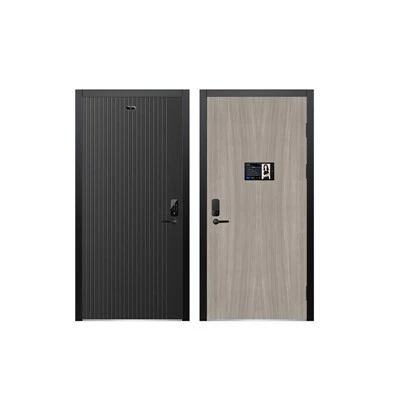
At the end of the day, the answer to “Does a wooden smart door have a self-closing function?” is: it can, if it’s designed right. It’s not a standard feature, but when it’s integrated with wood in mind, it’s one of the most useful parts of the smart door’s design. If you’re in the market for a wooden smart door and want to learn more about our self-closing models, or need help figuring out if it’s the right fit for your home or space, don’t hesitate to reach out to our team to discuss your requirements.
Fingerprint Door Lock References
- American Wood Council. (2022). "Durability of Solid Wood Doors in Residential Applications." Wood Product Industry Journal.
- International Code Council. (2021). "Requirements for Self-Closing Doors in Residential and Small Commercial Spaces." International Residential Code.
- Smart Access Technology Association. (2023). "Battery Life and Power Consumption of Low-Voltage Smart Door Systems." Access Control Standards Report.
- National Fenestration Rating Council. (2022). "Energy Efficiency Impact of Door Closure on Residential HVAC Loads." NFRC Technical Bulletin.
Guangdong Ap Tenon Sci. & Tech. Co., Ltd.
Guangdong Ap Tenon Sci. & Tech. Co., Ltd. is one of the most professional wooden smart door manufacturers and suppliers in China. With abundant experience, we warmly welcome you to wholesale advanced wooden smart door made in China here from our factory. Also, OEM service is available.
Address: No.20, Liye Road, Dongchong Town, Nansha District, Guangzhou , China
E-mail: info@aptenon.com
WebSite: https://www.tenondoorlock.com/
